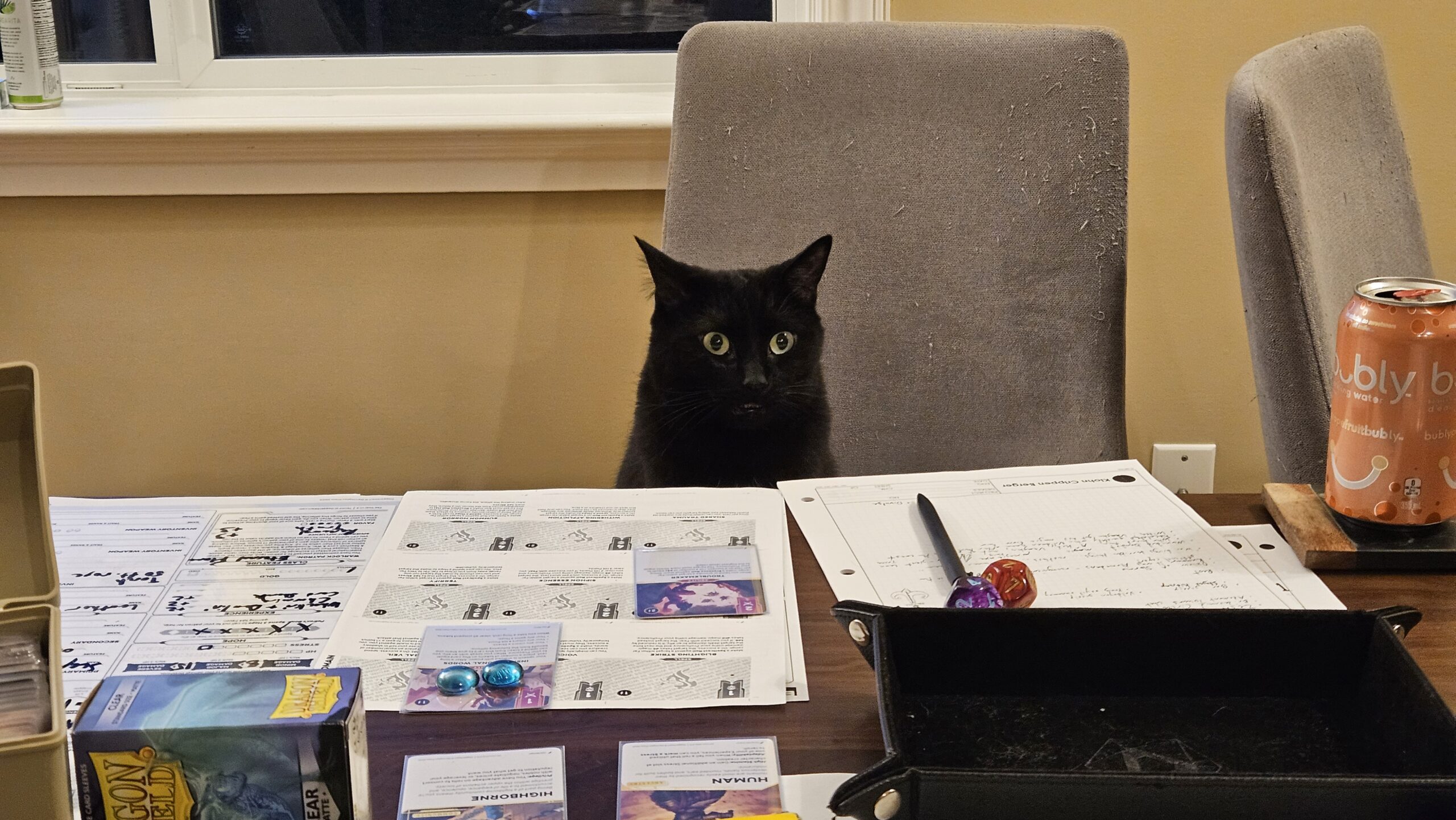
Hey everyone, I have been playing some Daggerheart both as a Player and a Game Master (GM). Now that we have the fully released ruleset, I figured I’d share some of my initial thoughts about it.
These are all in my video I posted. But for those who prefer less text and less rambling (and less fuzzy critters), this is for you!
Three of my favourite things about playing so far:
- The cards!
- Group checks
- The expectation that the players are creating parts of the scene, not just the GM
The Cards
For one, the art is beautiful (and human-made). As a player, I enjoy the ease of remembering what I can do with the cards out in front of me. It’s easier than searching through a multi-page character sheet that doesn’t have all the spell/ability details, or through multiple online or paper-copy resources. It’s modular, tactile, and visual. Plus, cards add to the overall fun of playing the game. Did I mention they’re super pretty?

One use case I enjoy is that Players can share a card with the GM or other Players to help communicate what they’re trying to do. I also find it way easier than trying to cram everything into a character sheet.
| Tip: if you’re playing multiple sessions, take a photo of your cards at the end of each session to help you remember what build you had next time you play! |
Load out
You can have a maximum of five active domain cards in your “loadout”. Which is like your “hand” of cards. This doesn’t come into play until higher levels, when Players have more than five domain cards.
Moving cards from your “vault” (which is like your inactive “deck” of cards) to your loadout can be done during a rest. However, if you want to move a card while a scene is in play, it’s stressful. There’s a little currency you need to pay attention to. Check out the top right-hand corner of the domain card. That number is how much Stress you need to spend to exchange that card for another in your loadout.
Group Checks
I know it’s not a new thing for tabletop roleplaying games to have group checks. But I like the way they spell it out in Daggerheart.
In Daggerheart, the Gamemaster may introduce a challenge where a group check makes sense.
For example…
The Players are trying to scale a cliff
The GM sets the difficulty appropriately, and then the Players decide who will be ‘Leading’ the group roll.
Everyone assisting in the check will roll first. This is a Reaction Roll, so no Hope or Fear is awarded. For every check that beats the difficulty, the Leader gets an additional plus 1 to their roll. But each failure results in an additional minus 1.
Finally, the Leader makes the check and applies all modifiers. This includes the bonuses or minuses from the Players assisting in the check. Identify if the roll was made with Hope or with Fear, and you have your final group check result!
I find using group checks in this way helps the flow of the game. Plus, it furthers emphasizes collaboration among the players. Starting to see the theme?
You used the term Reaction Roll. What does that mean?
A Reaction Roll is where a player rolls both their Hope and Fear die and adds them plus modifiers, as applicable. BUT you don’t include the Hope or Fear mechanic in a Reaction Roll. I like this, because otherwise you’re building up way too much Hope and Fear. If you want more Hope or Fear in the game, as the GM you can always get the Players to roll more. If you just want the Players to make a quick check, Reaction Rolls are a nice way to avoid feeling like you’re handing out Hope (and getting Fear) too often.
Sometimes I’ll have Players make a Reaction Roll for something inconsequential, or if they’re contesting another Player. Reaction Rolls are also used mechanically in certain situations or with certain abilities.

Player Expectations at the Table
I know that D&D and other TTRPGs are all ‘collaborative storytelling’. But for the games I’ve played, that doesn’t mean any less work for the Game Master. With Daggerheart, there’s this expectation that when you sit down at a table together, the Players are contributing just as much to building each scene as the GM. It’s not just the GM coming up with everything.
I find that when I ask Players to come up with stuff in D&D, they often feel put on the spot. Then, once that initial shock has worn off, they’ll come up with something cliché (which, okay) or half-assed (less okay). With Daggerheart, and maybe I’m just fortunate to have played with awesome players so far, it’s a totally different vibe.
This game encourages improvisation and thinking on the spot in a different way than I’m used to with other (larger) TTRPGs that I’ve played. Yes, many of the small and independent games you’ll play force you to come to the table wanting to improvise, because there isn’t as much content or rules already developed. And yes, some Players are just going to bring more of that to a game. But I stand by my belief, reinforced by some experience, that Daggerheart does bring out more collaborative storytelling by design.
Quashing Fear
I’ll be honest, when I first started following the game design process and then beta tested materials… I was worried Daggerheart would need a lot more preparation than my average D&D game. My typical preparation for D&D adventures is to put in a few hours in the week leading up to each session. But with Daggerheart, I’m averaging no more than an hour of prep time for similar gameplay.
I’m finding the main difference is that Players come to the table with an expectation that they are part of the role-playing. They are part of scene creation. I’m not creating the world; we are telling the story together.
Players might ask, “Hey GM, what do I see?”
And I can turn that right around and ask them, “What do you see?” For example, “You know you’re in a field, but what kinds of plants are there? Are there any trees? How about animals or other people?”
And they seem a lot more responsive to jump into crafting that scene with me than when I’m playing D&D.

All this is to say, I’m having a great time playing Daggerheart. It’s less work to prepare as a GM. I’m finding it easier to lower my expectations as both a GM and a Player. While having just as much fun and developing just as much of a rich story.
If you’re curious about my early thoughts on the game, you can check out: